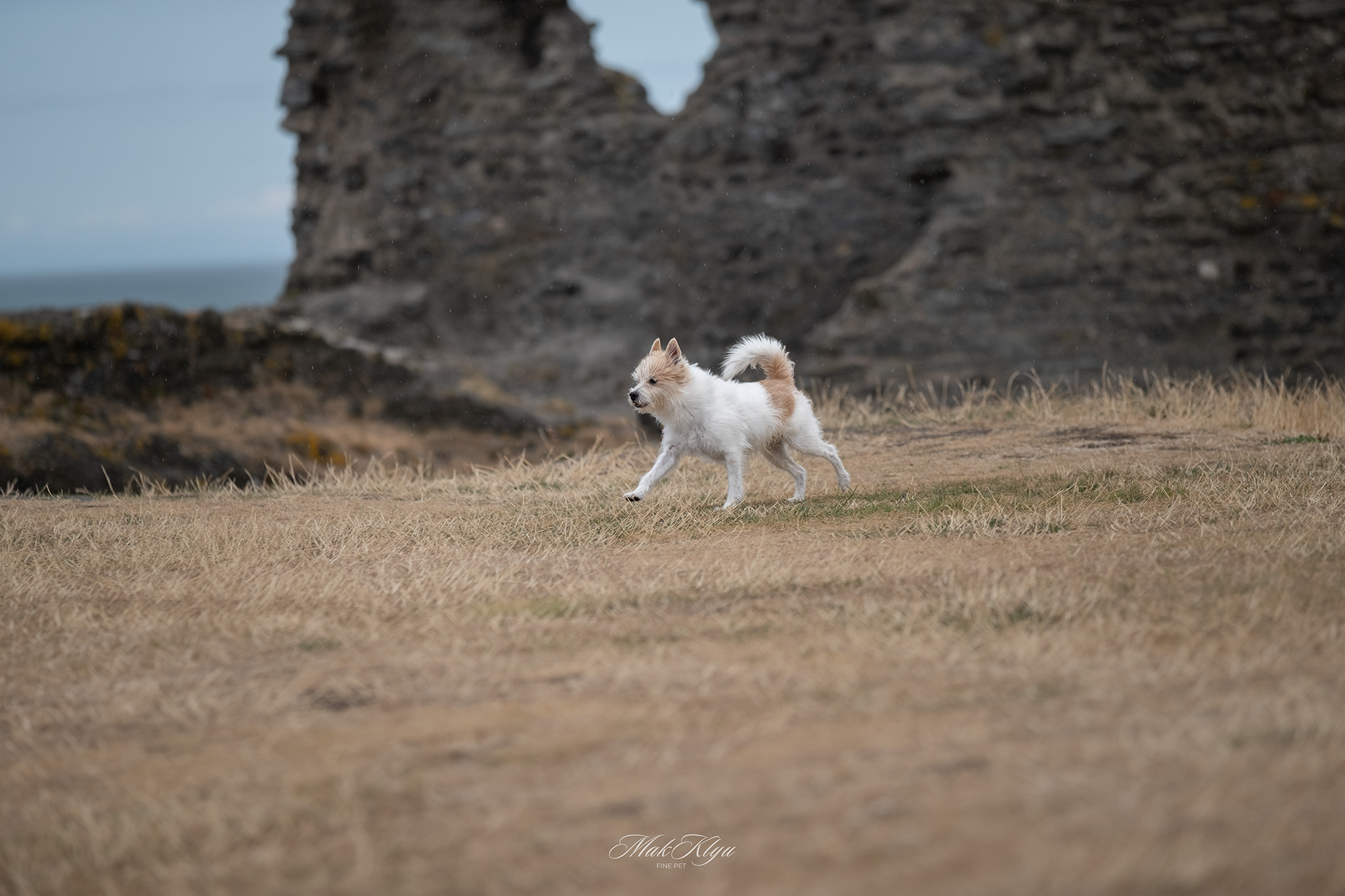
Coastal dog photography is not only about placing a dog against a beautiful view.
It begins with recognising what a place allows.
Some landscapes invite stillness.
Others create a sense of shelter, closeness, or quiet attention.
An open coast offers something different.
Its paths continue beyond the frame, the wind moves through grass without asking permission, and the horizon leaves no clear boundary between curiosity and distance.
In such a place, a dog does not need to be arranged into the landscape.
The dog begins to explore it.
Before the Dog Enters the Frame
A coastal story often begins without its main character.
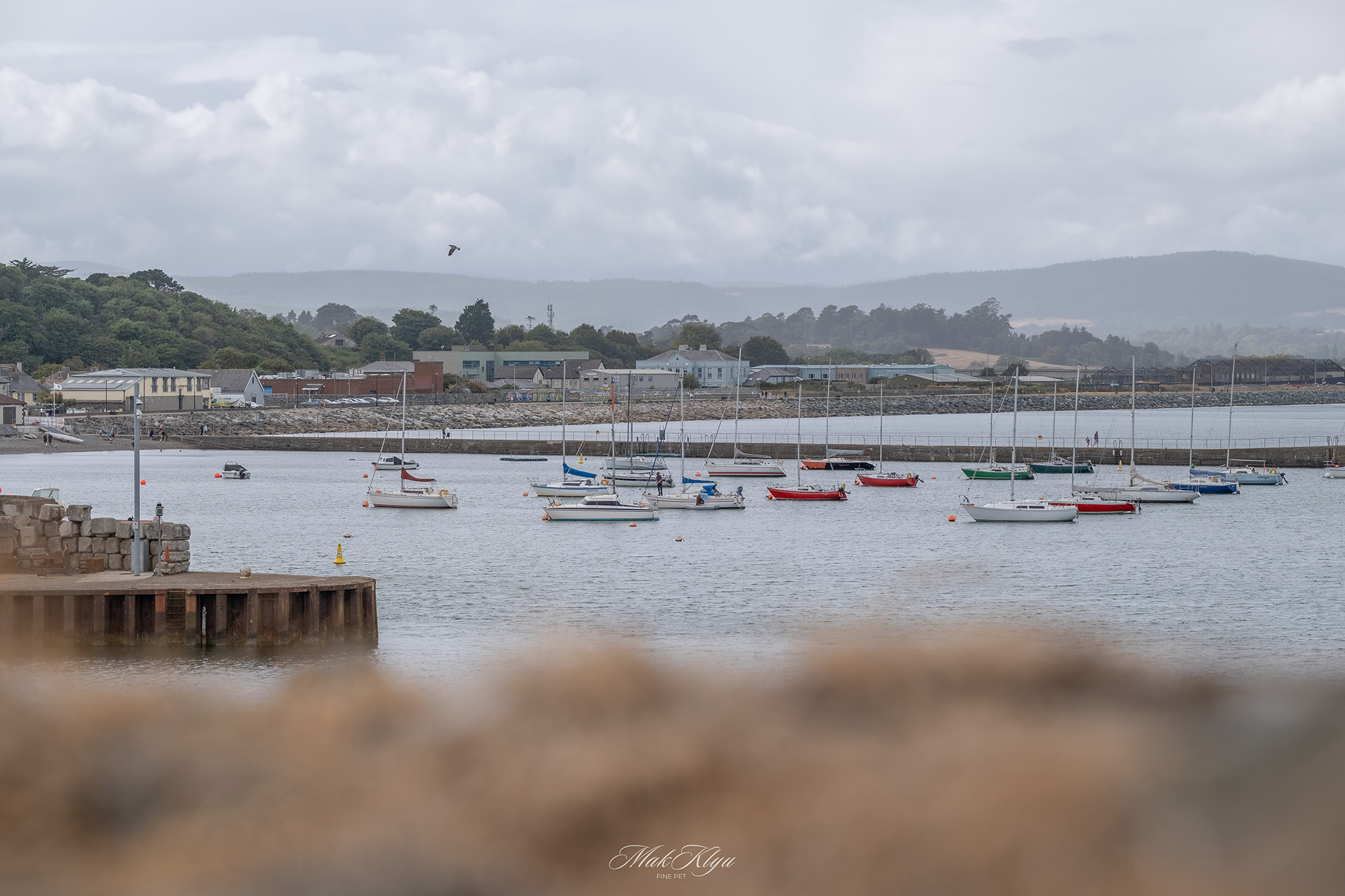
From a distance, the shoreline appears as a meeting of muted colours: pale land, grey-blue water, low buildings, and a sky carrying more weather than light.
Nothing immediately demands attention.
The landscape reveals itself gradually.
This first view matters because it establishes more than location.
It creates emotional scale.
Before we see movement, we understand distance.
Before the dog enters the frame, we sense that the world around it will remain large.
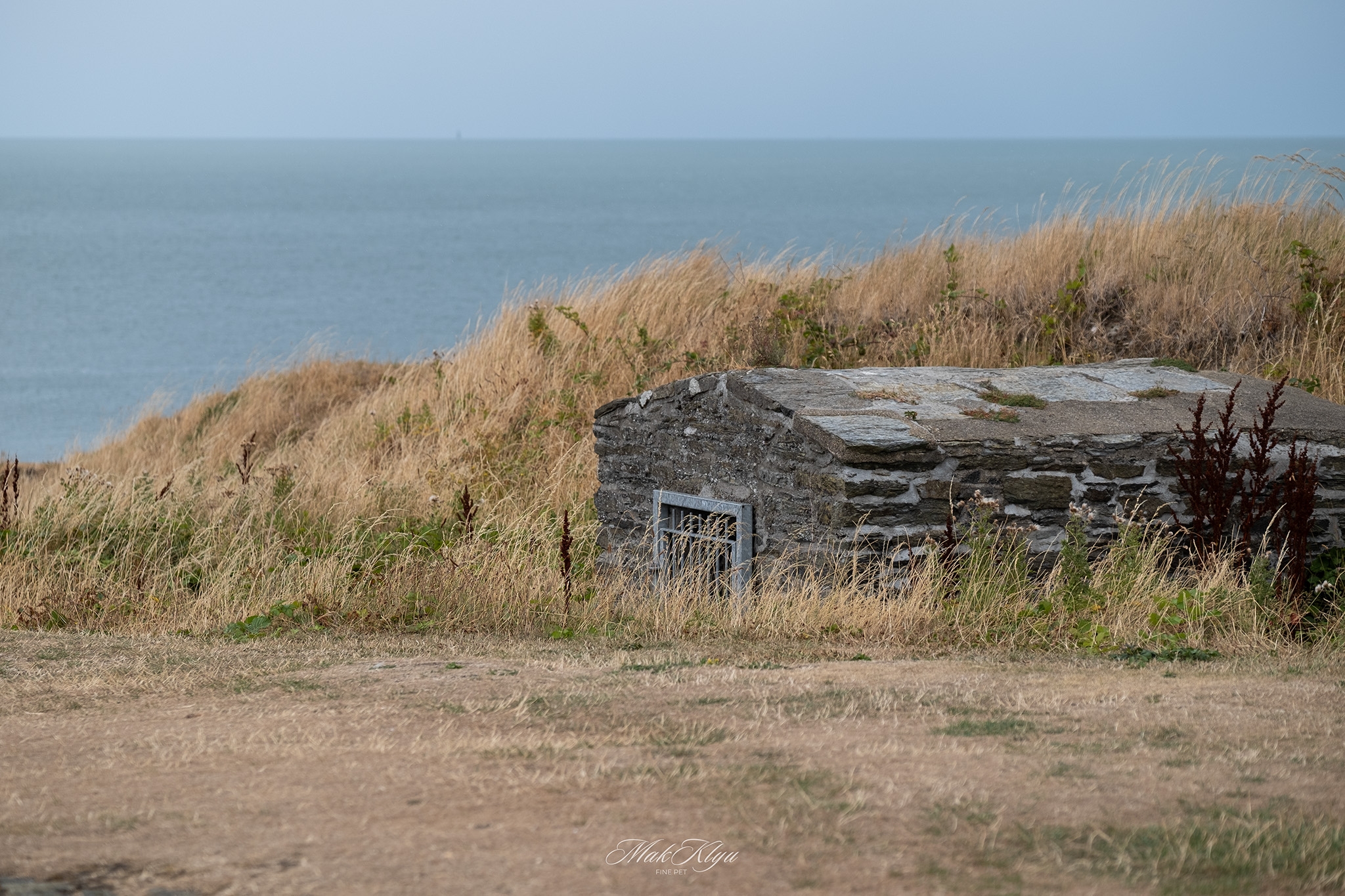
As we move closer, the coast becomes less gentle.
Grass gives way to rock.
The edge of the land becomes uneven, and the water begins to feel deeper.
What appeared calm from afar now contains ledges, hidden descents, narrow passages, and surfaces shaped by exposure.
The landscape is not an empty stage waiting for a subject.
It already has direction, tension, and character.
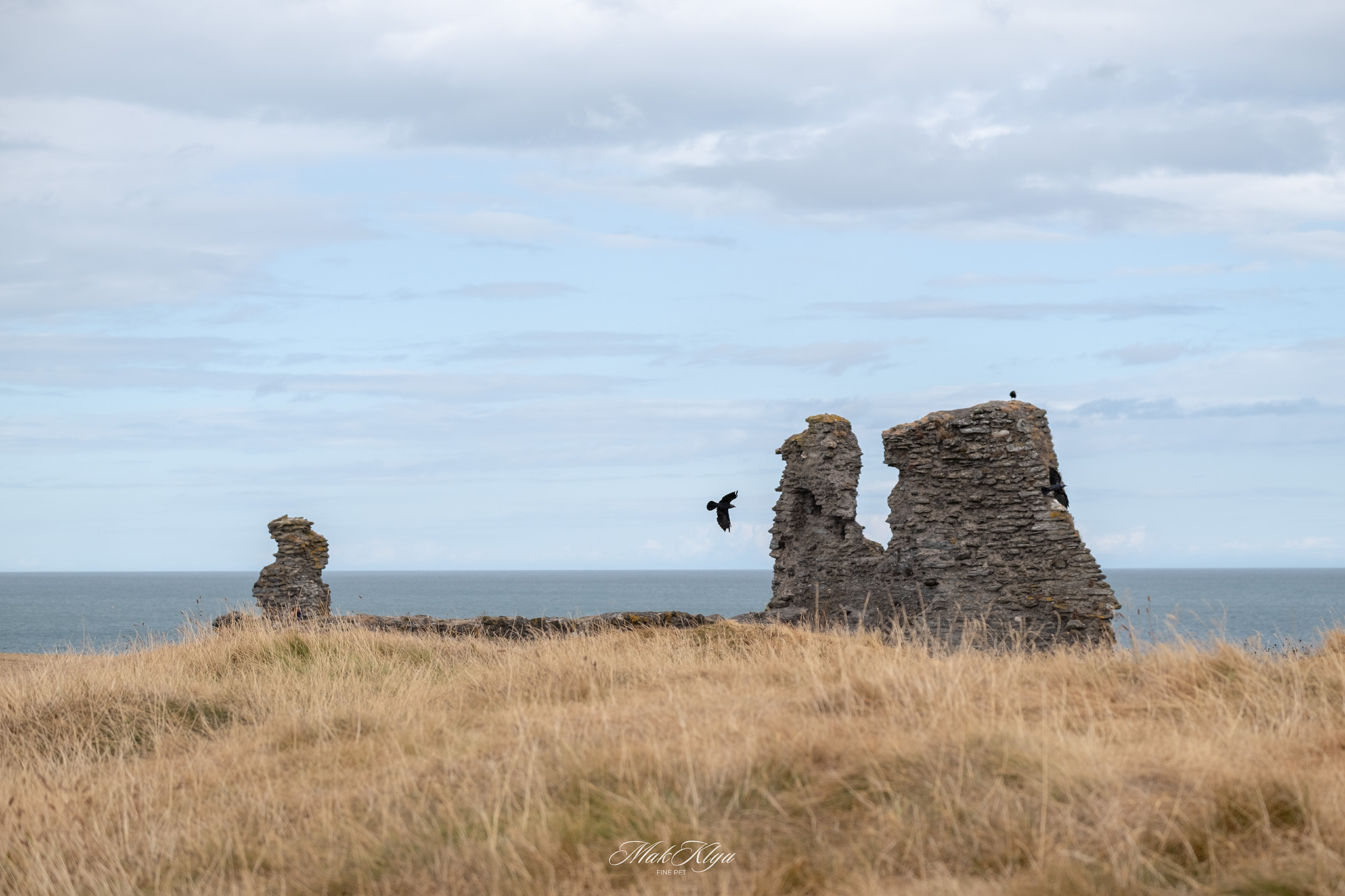
Weathered stone ruins rise from the dry grass between land and sea.
Their broken forms divide the open horizon and create a series of ledges, openings, and distances.
Several dark birds rest on the stone while another moves through the air between them.
Their presence reveals that the ruins are not only a visual landmark.
They have become part of the living landscape: a place in which stillness and movement exist together.
Even before the dog appears, the photograph begins to speak about freedom as the ability to find one’s own place within a wider world.
This idea will return when the dog enters the landscape.
The Coast Creates Its Own Rhythm
Open landscapes are often described as empty, but this emptiness is rarely still.
The coast contains movement at several different speeds. Water changes slowly across a wide surface.
Wind passes quickly through the grass.
Weather approaches almost invisibly.
A narrow path suggests where a body might travel before anyone begins to follow it.
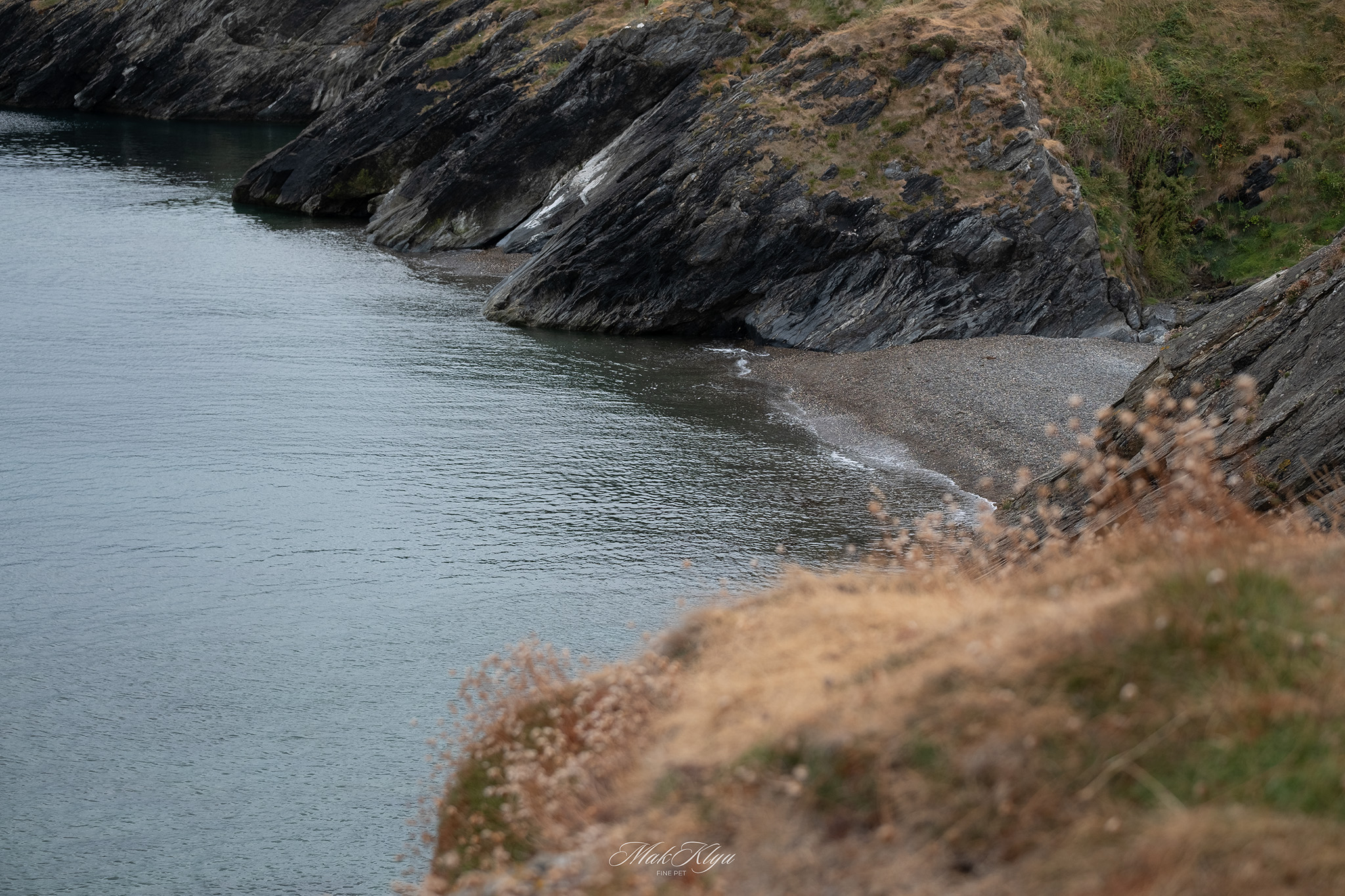
Seen from above, the shoreline reveals its structure.
Dark rock enters the water in repeated forms.
Small curves of beach appear between larger surfaces.
The coast does not create one direct route.
It offers a sequence of openings, interruptions, and changes in direction.
For a photographer, these structures become part of the composition.
For a dog, they become possibilities.
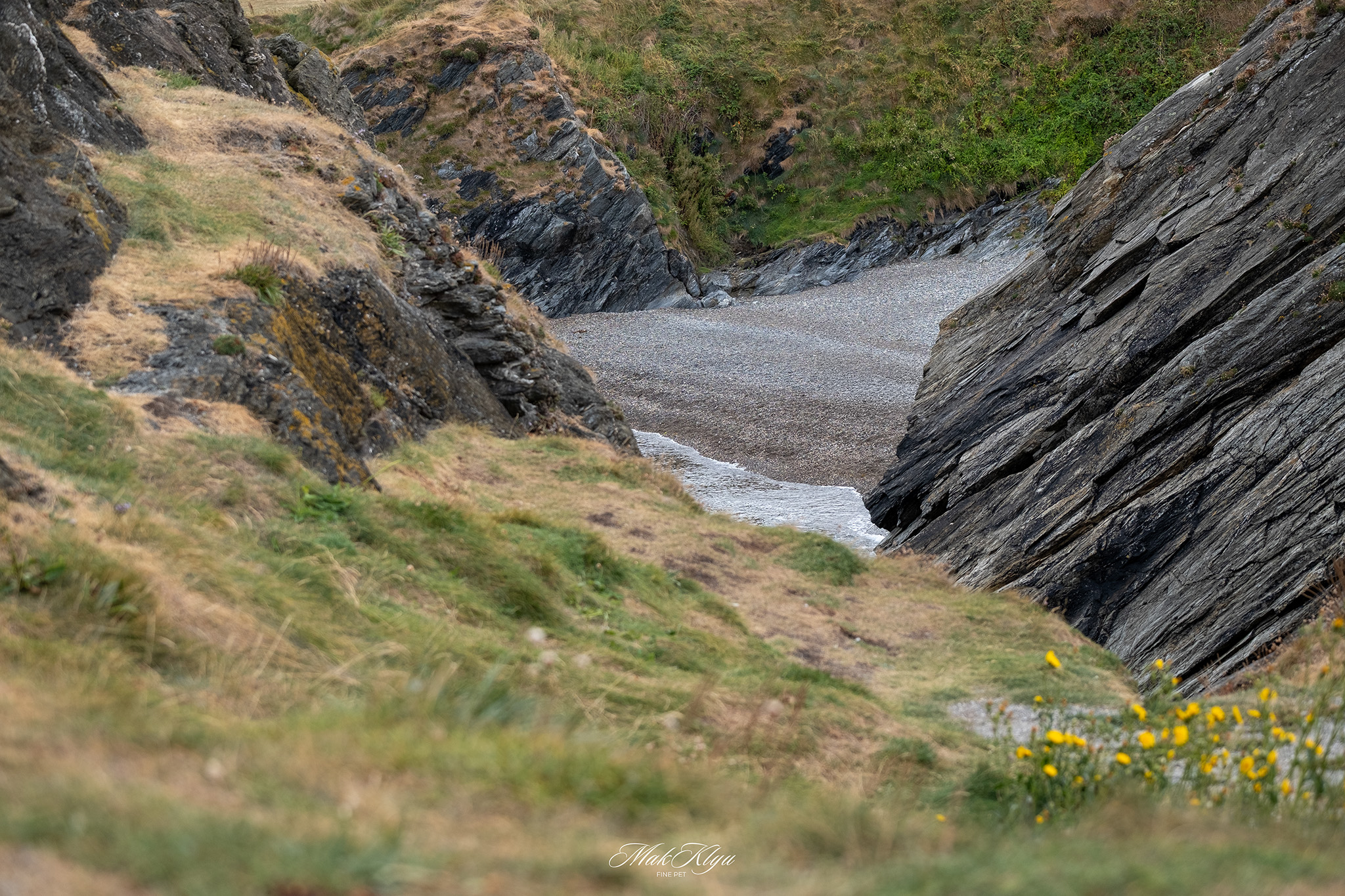
A narrow beach rests between steep walls of stone.
It feels both open and enclosed: connected to the sea, yet protected by the shape of the land.
This contrast is important.
Freedom does not always require limitless space.
Sometimes it begins with a place that encourages movement while still providing a sense of direction.
A dog may follow a slope, disappear behind a rise, pause at the beginning of a path, or choose a route that the photographer had not noticed.
The landscape allows these decisions to happen naturally.
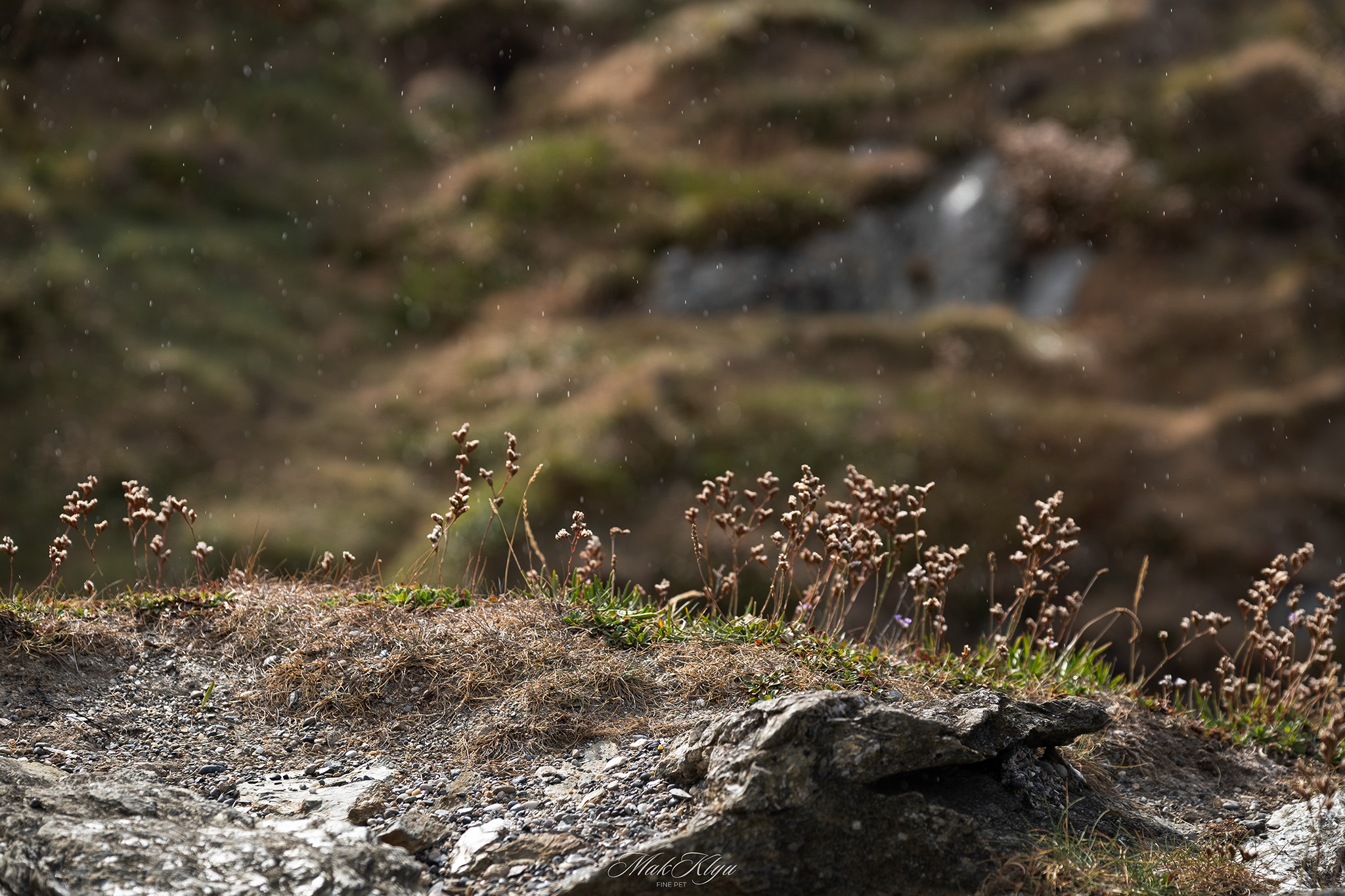
Then the weather becomes visible.
Fine rain passes through the frame above dry coastal plants.
The droplets are small, but they alter the atmosphere of the entire photograph.
What seemed quiet now feels temporary.
The light may change.
The wind may strengthen.
A clear path may become less certain.
Animals respond to these changes before we always recognise them ourselves.
Their posture shifts. Their attention moves. Their pace becomes quicker or more deliberate.
The weather is not separate from their behaviour.
It helps shape it.
Coastal Dog Photography Begins with Space
When the dog finally appears, the landscape has already taught us how to see it.
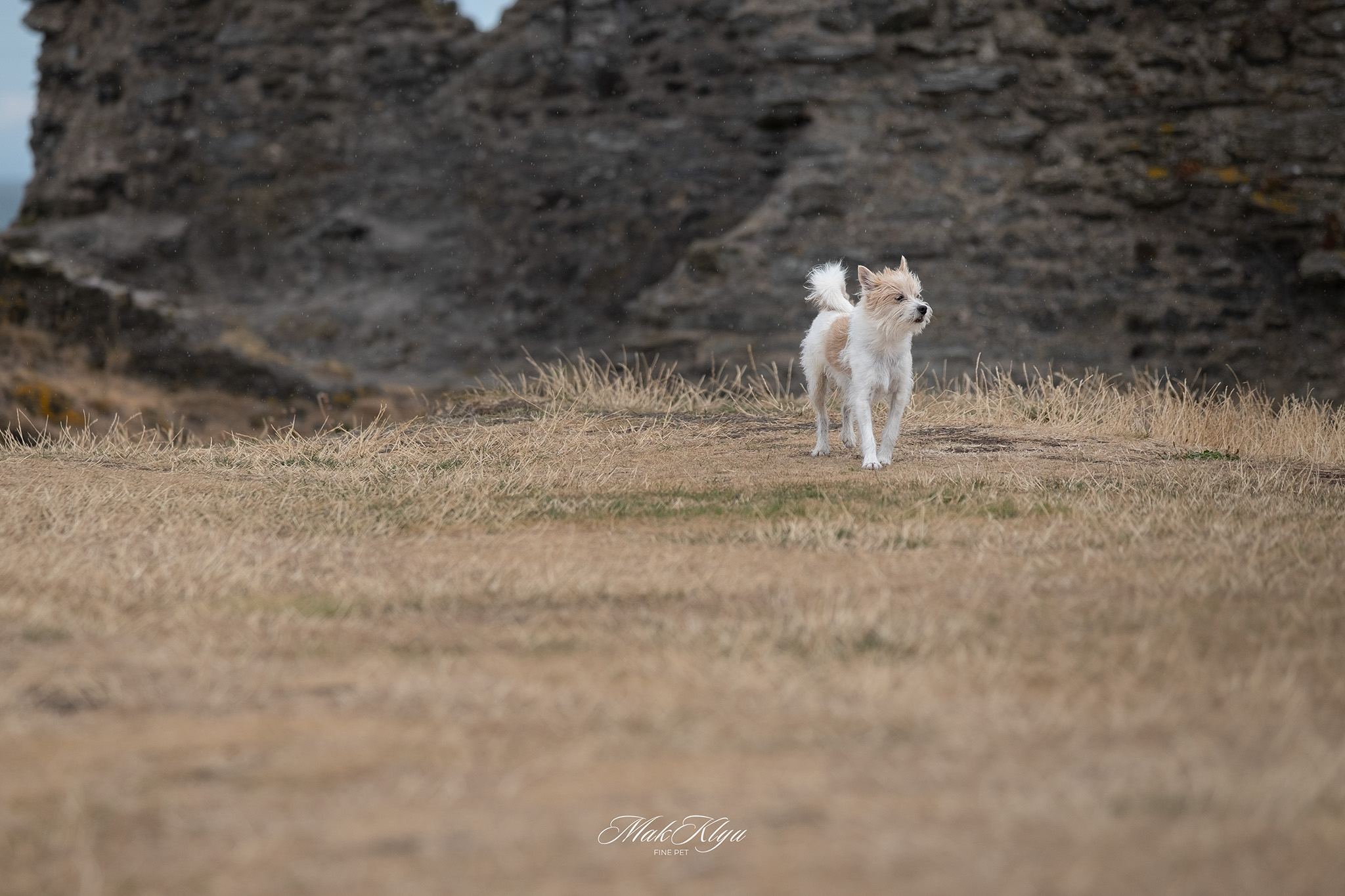
A small white dog stands alone in the dry grass.
The figure is clear, but it does not dominate the photograph.
Behind it, the dark stone ruin carries its own history and visual weight.
The dog pauses with its head turned, attentive to something beyond the frame.
Nothing in this moment needs to be corrected.
The uneven ground, the open distance, and the direction of the dog’s attention already create the portrait.
This is one of the gifts of photographing dogs in a spacious natural environment.
Character can appear through choice rather than instruction.
A pause becomes watchfulness.
A turned head becomes curiosity.
A decision to remain still for one brief moment becomes part of the story.
Freedom Cannot Be Directed
A dog moving freely across a landscape does not follow the visual plan imagined by the photographer.
It may come closer and then turn away.
It may disappear behind grass, choose the edge of a path, or stop in a place that initially seemed insignificant.
This unpredictability is not an obstacle to the photograph.
It is often its most truthful element.
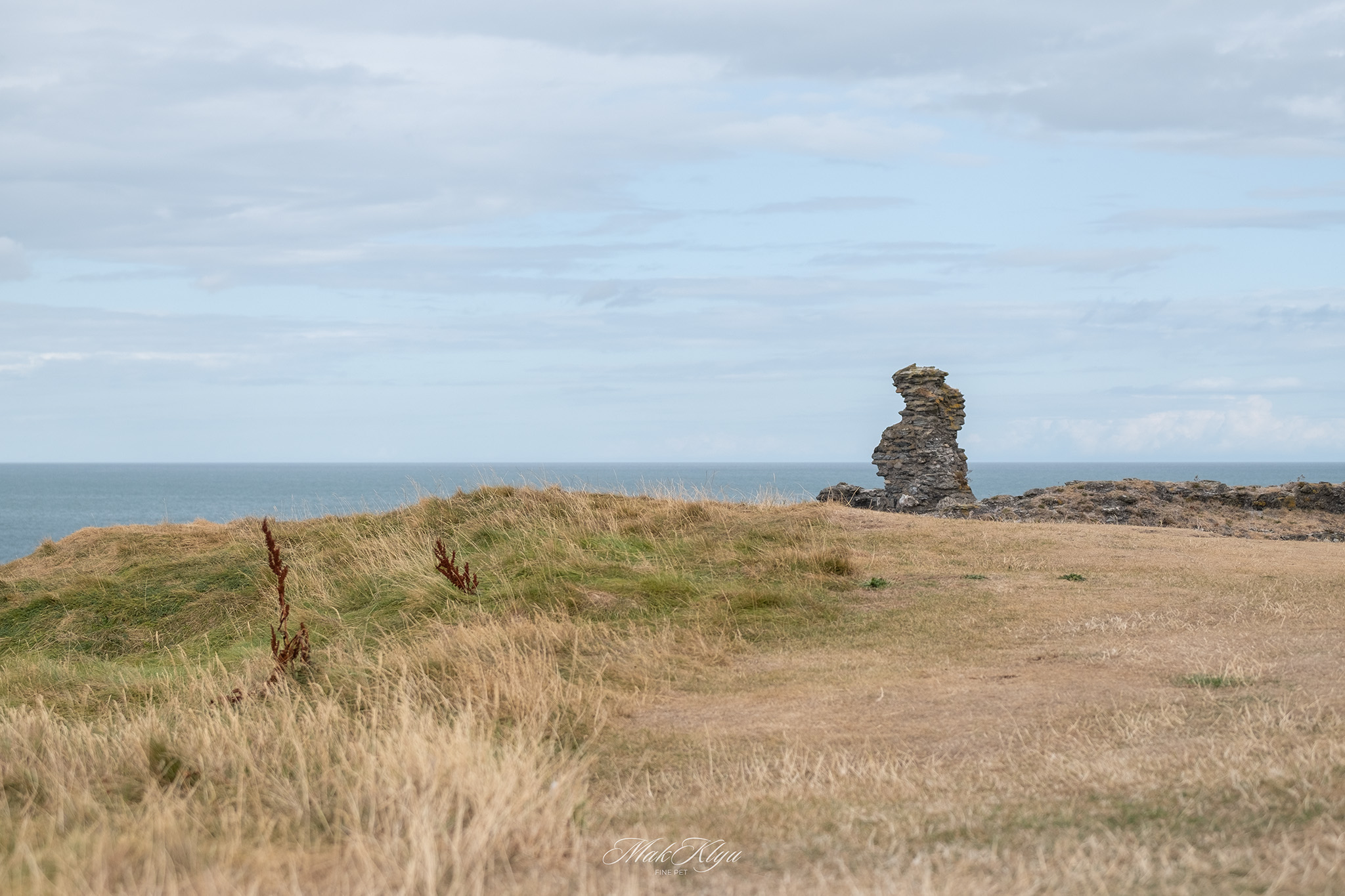
From farther away, the dog becomes smaller and the relationship with the coast becomes more visible.
The body no longer carries the whole meaning of the frame.
Direction becomes important.
So does the open space ahead of the animal.
The photograph begins to suggest not only where the dog is, but where it may go next.
Movement creates anticipation.
The image remains unfinished in a beautiful way.
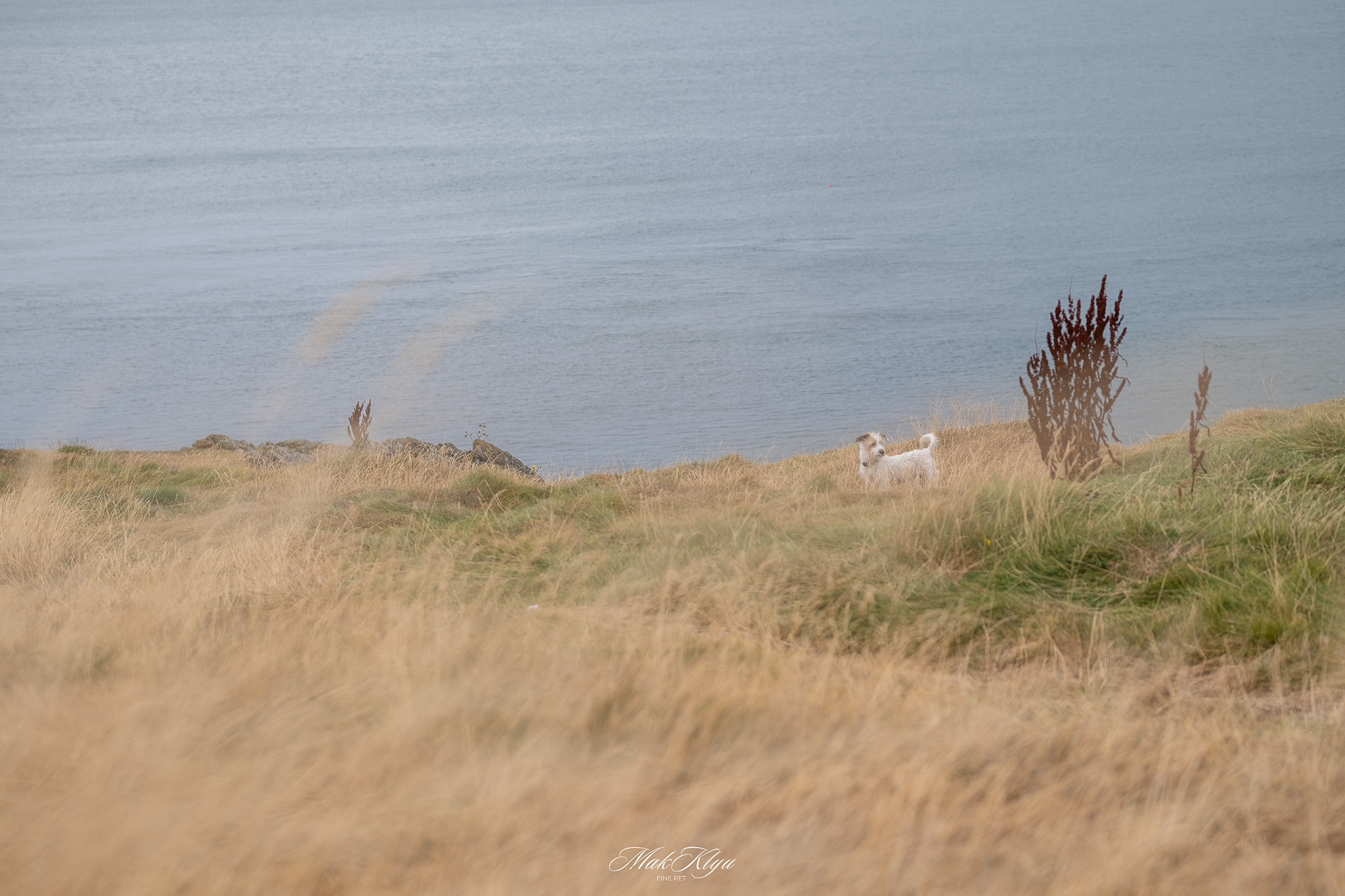
Farther along the slope, the dog nearly disappears into the grass.
Its pale body is interrupted by plants, distance, and the changing level of the ground.
The sea occupies most of the background, quiet and immense.
The dog has not become less important because it is smaller.
Instead, the viewer participates in finding it.
This is where scale becomes emotional.
The photograph does not separate the animal from the world in order to make it visible.
It allows the dog to belong to that world completely.
The result is not a portrait of control.
It is a portrait of freedom.
When Space Becomes Shared
Freedom does not always mean solitude.
An open landscape can allow animals to approach one another without forcing the meeting into the centre of the frame.
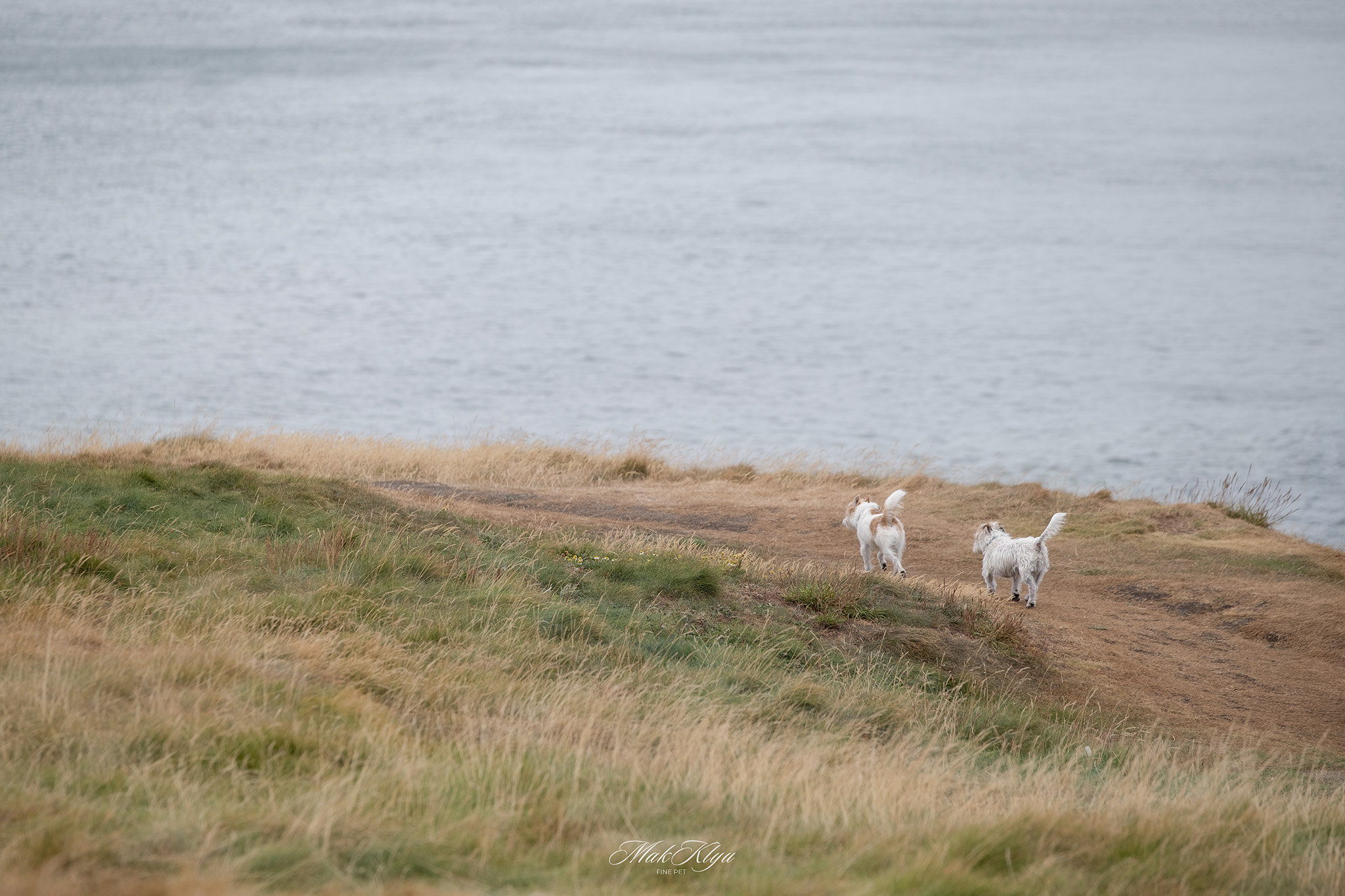
Two small dogs stand on a path above the sea.
They are close enough to acknowledge one another, yet each retains its own direction and posture. There is no need for them to face the camera or perform the same action. Their relationship is expressed through distance, attention, and the shared space between them.
The coast gives the encounter room to remain natural.
One dog can pause while the other continues.
They can meet without becoming a posed pair.
They can share the landscape without losing their individuality.
This is often how genuine relationships appear in photographs: not through perfect symmetry, but through the quiet negotiation of space.
Returning to the Wider Landscape
After following the dog, the eye eventually returns to the coast itself.
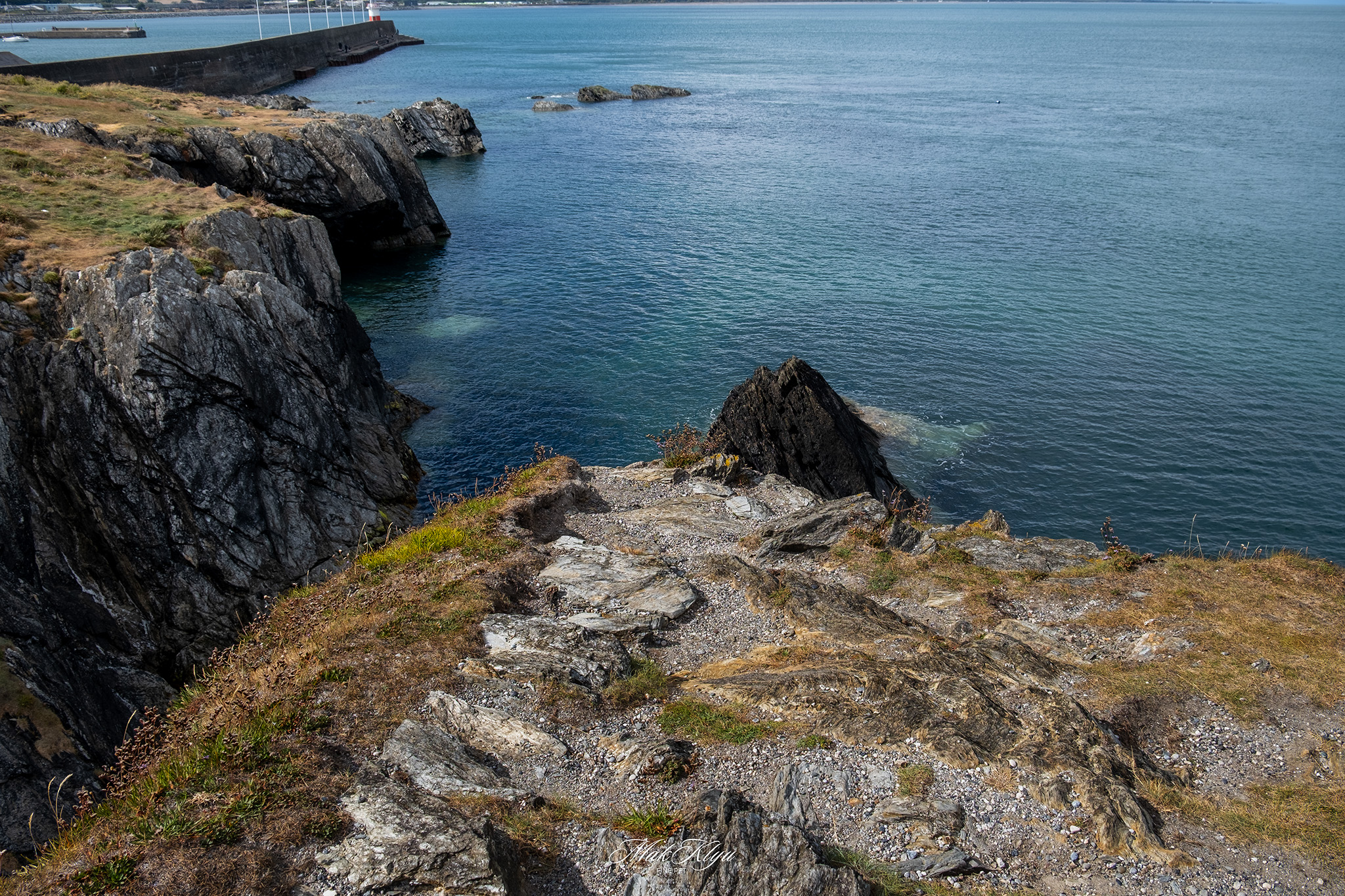
From the rocky edge, the view opens towards the water, the harbour wall, and the distant lighthouse.
Nature and human presence exist within the same frame.
The rocks remain rough and irregular, while the harbour introduces a clear constructed line.
Neither cancels the other.
This is also part of the landscape through which dogs move.
Their freedom does not require a world untouched by people.
It exists within paths, meetings, boundaries, familiar voices, and the possibility of returning.
The dog can move away without the connection disappearing.
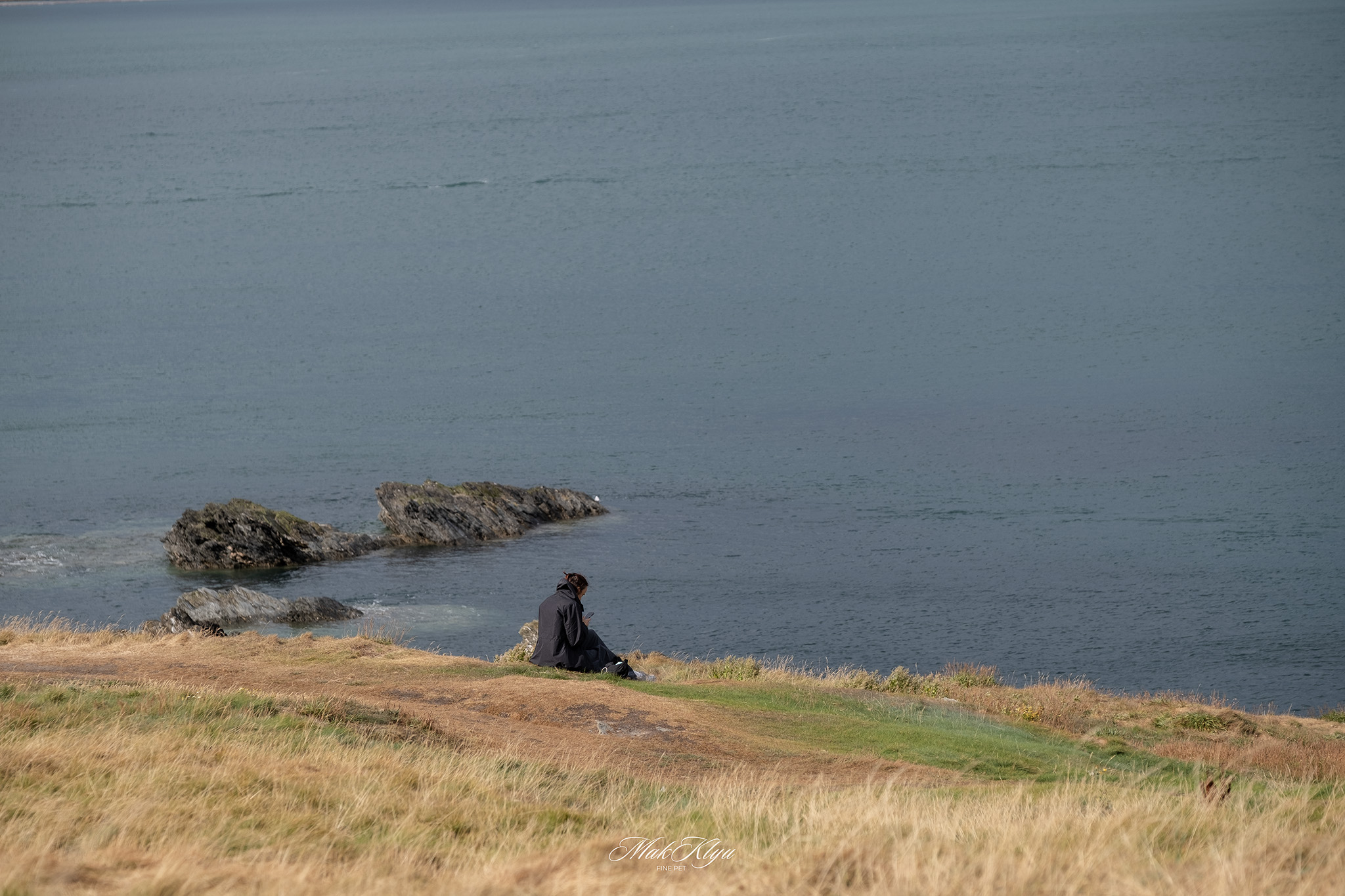
A person sits quietly near the water.
The figure faces the sea, absorbed in the distance.
At the lower edge of the landscape, the dog is only partly visible.
There is no obvious gesture of affection and no attempt to bring both figures together for the camera.
Yet the relationship remains present.
The dog has been free to explore, to move through grass, to meet another dog, and to become almost invisible within the wider coast.
Now the human presence quietly completes the story.
Closeness does not always mean remaining side by side.
Sometimes it means having enough trust to move through the world independently and still belong to the same moment.
The Landscape Does Not Hold the Dog Back
A coastal landscape does more than provide a dramatic background.
It gives movement a direction, distance an emotional meaning, and natural behaviour enough room to become visible.
It allows the photographer to observe without deciding everything in advance.
The dog may stop, run, disappear, return, or choose a path we had not intended to follow.
That is not a failure of the portrait.
It is the moment the portrait becomes true.
The strongest images are not always those in which the animal is closest to the camera.
Sometimes they are the ones in which the surrounding world remains fully present and the dog is free to find its own place within it.
The coast does not ask the dog to perform.
It simply gives the dog room to be.